
I have been living in Spain for more than 20 years and am embarrassed to confess that I am not very good at the language.
Adapting
I spent the first years of my life in the southeast of England before emigrating to Spain in 2004.
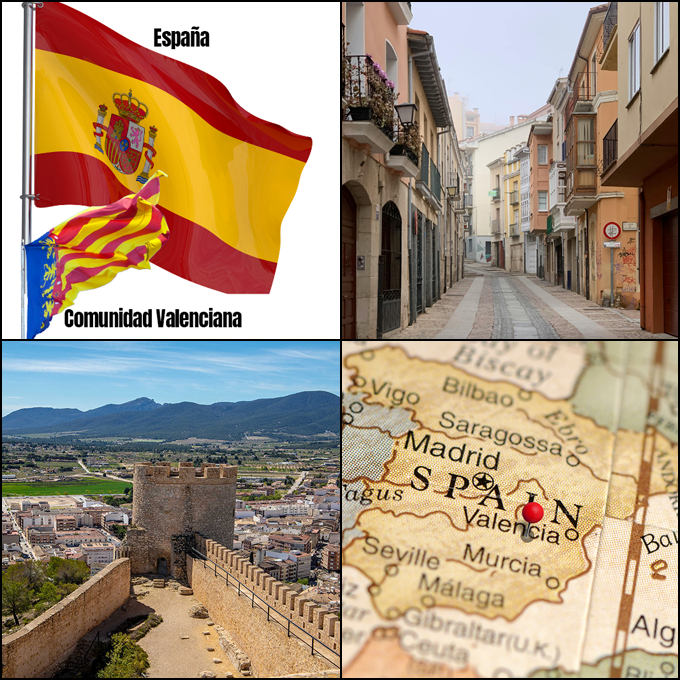
My husband and I moved to the southeast of Spain in the mountainous region inland from Alicante on the Costa Brava in the Valencian Community.
We own a small ‘caseta’ (house) on the top of a small mountain. Our views are stunning in all directions, we have very few neighbours, and we encounter almost nobody when we are at home. To me, this is bliss!
The town we live in has a population of almost 12,000 and is within a group of small towns called the Castalla Valley. I have no idea why it’s called a valley as we are way above sea level at 675m (2,215ft). I imagine it is because we are in a valley in the mountains.
Spain offers a much slower pace of life than the UK, and this takes a lot of getting used to. If you book a workman to do the job on Monday, be sure to ask, ‘Which Monday?’ before agreeing. He/she will turn up on Monday, but not necessarily next Monday! This is acceptable practice here.
Notable Lifestyle Differences
Notable differences between life in the two countries that take adapting to are:
- Communal bins: The bins are emptied often, but you have to take your rubbish to a communal bin. If you live in an urban area, they will generally be within easy walking distance. If you live in a rural location, it may well be a drive to the bins.
- Siesta time: The shops close from around 1 to 1.30pm and re-open at around 5pm until about 8 or 8.30pm. No independent shops other than bakers are open before 10am. Exceptions to these hours are petrol stations and chain supermarkets. Shopping malls are usually open all day too.
- Red tape: If you think there is a lot of red tape to be negotiated in the UK, they have nothing on Spain! Every single thing you want to do, you will need to present numerous documents and often it will have to be notarized – at a cost, of course!
- Babies and children in bars: When you have children in Spain, you do not change your way of life for your new addition, the child will go where you go. Bars are often full of babies and kids! There are no rules about who admonishes a child either – if the child is bothering you, you have the right to shout at it or at least tell it. That doesn’t mean you can put your hands on it, but the saying ‘it takes a village to raise a child’ was never more observed than in the small towns of Spain. It is never unusual to see two or three breast feeding mothers at one table in a bar.
- Conversation: When there are three or more Spaniards at a table, the sound level would be equivalent to about 10 Brits. Conversation is conducted all at once, over the top of each other. I never realized how politely the Brits converse, waiting for one to finish before another starts speaking! It’s like a drunken brawl at 10 in the morning here!
- Patience: The Spanish have endless amounts of patience in just about any situation. If the checkout worker is talking with a customer, that’s fine, they will wait patiently, etc. Right until they get behind the wheel of a car… then they have absolutely no patience at all! However, as pedestrians, they think they rule the road – if they wish to stand in the middle of the road and talk, who are you, a mere car driver, to try to move them out of the road??? I am perfectly sure this doesn’t happen in places like Alicante, Granada, Madrid, and Barcelona, just in the small, sleepy towns.
Language Barrier… What Barrier?
When I moved to this town hardly anyone spoke English. Learning Spanish was a must, and I did have private lessons for a time. My Spanish is passable, but not even at conversational level. This is because as soon at the English started to move in here (an urbanization was developed), the locals saw it as the perfect opportunity to learn English, which we, of course, let them do because we are so lazy when it comes to learning languages.
For a long time, and still at times, the Spanish will say ‘We can speak English, I need to improve.’ But you will hardly ever hear the English say that about the Spanish language, they just embrace the situation.
Finally…
Be sure that if you are going to drive in Spain, you understand the priorities on the road. The most important is bicycles – cycling is a major sport here, and cyclists ride two or three abreast and will not drop to single file because a car wishes to overtake them. By law the car has to give 1.5m clearance to cyclists, which they make almost impossible at times.
Second in importance in the town centre is pedestrians, as mentioned above. Finally, the lowly car – the only one of these three that pays road tax – gets a look in!
If you enjoyed this, drop back in, there will be more on life in Spain.
While I have done my very best to ensure the information contained in this article is up to date, please be aware that information can change at any time due to weather conditions, changes of address, changes of website address, etc. If you find any incorrect information, please contact me at carol@me-alone.com, and I will happily update it.
Leave a Reply